Curating an Authentic Mexican Art Gallery Wall in a Contemporary Apartment
Blog
6 min read

Staring at a blank white wall with a collection of folk textiles often leads to visual clutter rather than intentional design. Creating an authentic Mexican art gallery wall requires anchoring the layout with a primary focal piece at eye level, keeping two to three inches between frames, and framing dimensional crafts in clean, minimal profiles. This deliberate spacing ensures hand-embroidered textiles and organic paper art enrich the room without overwhelming modern architectural lines.
Traditional Mexican decorative art is known as arte popular, a heritage term encompassing indigenous and regional folk crafts passed down through generations of community makers. Rather than commercial tourist souvenirs, authentic arte popular represents skilled master handcrafts ranging from Otomi relief embroidery in Hidalgo to hand-beaten amate bark paintings from Guerrero. Bringing these regional craft forms into an apartment bridges ancestral storytelling with modern residential design.
Heritage Mediums and Curation Formulas
A balanced gallery display pairs tactile heritage mediums with intentional dimensional variety to create clear visual depth. Hand-embroidered Tenango de Doria textiles from Hidalgo and natural amate bark paintings from Guerrero provide dimensional texture that flat prints cannot replicate. Combining these diverse materials in pre-planned groupings helps establish an intentional aesthetic instead of a chaotic wall of souvenirs.
For narrow hallways or compact entryways, a linear trio balances height and texture without overcrowding available wall space. Center a 24-by-24-inch framed Otomi embroidery as the visual anchor, flanked by two vertically stacked 11-by-14-inch amate bark paper paintings on one side and a single hand-carved mask or ceramic accent on the other. Incorporating a three-dimensional ceramic element provides a sculptural break from flat glass, creating an immediate sense of collected heritage.
In larger living rooms, a five-piece asymmetrical salon arrangement offers expanded storytelling. Anchor the grouping with a generous 30-by-40-inch framed textile, then balance the perimeter with two 8-by-10-inch botanical amate studies, a 12-by-12-inch gouache painting, and an unframed sculptural accent such as a small clay wall sconce. When selecting embroidered pieces, exploring artisan wall art collections from cooperative-backed sources ensures that the animal and floral motifs preserve regional needlework traditions and precise proportions.
Sourcing pieces directly from certified artisan cooperatives or dedicated purveyors ensures fair wages and preserves traditional production techniques. For collectors balancing vibrant cultural artistry with a quiet aesthetic, choosing monochrome Otomi textiles in neutral cream, slate, or charcoal allows rich stitchwork to stand out without clashing against existing furniture. Readers exploring these design nuances can learn more through Lanna Ha's guide on the symbolism of colors in Mexican Otomi embroidery.
Scale, Spacing, and Visual Weight
Consistent spatial planning prevents a multi-piece cultural arrangement from feeling chaotic. Position the vertical center of your primary focal piece between 57 and 60 inches from the floor, which aligns directly with standard human eye level. From this anchor, build outward while maintaining a uniform gap of two to three inches between adjacent frames. Preserving identical margins across the entire collection gives the arrangement a cohesive structure, even when the individual frames hold vastly different shapes and textures.
Visual weight must be distributed deliberately so one quadrant does not drag down the entire wall. Place your largest framed textile slightly off-center or low in the layout, balancing it across the central axis with two smaller framed prints or drawings. In a discussion about an unbalanced living room display, an observer pointed out that hanging the largest piece at the top while varying spacing between three inches and a foot caused the arrangement to feel disjointed. Keeping gaps tight and identical maintains visual calm across mixed frame dimensions.
Framing Techniques for Textured Media
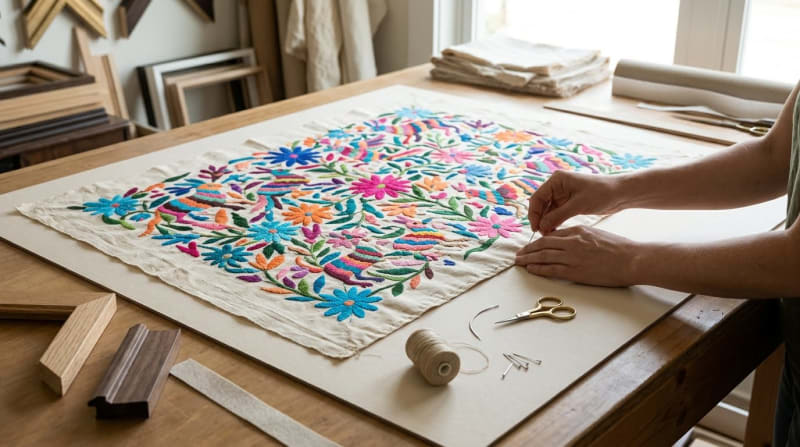
Archival framing transforms handmade textiles and bark papers from casual keepsakes into museum-grade installations. Traditional Mexican crafts feature organic, irregular edges that should be celebrated rather than covered by commercial cardboard borders.
Float-mounting bark paper paintings with spacers allows their natural deckled edges to hover slightly over an archival backing board, casting gentle shadows that emphasize the beating of the tree bark. For hand-spun cotton embroidery, incorporating fabric mats in warm linen, tobacco velvet, or forest green creates a soft, light-absorbing border that accentuates delicate satin stitches. The table below outlines how different media benefit from specific framing and matting methods:
| Heritage Medium | Mounting Technique | Matting Style | Frame Profile |
|---|---|---|---|
| Otomi Embroidery | Pinned over archival foam board | Recessed velvet or natural linen | 0.75-inch natural walnut |
| Amate Bark Paper | Float-mount with interior spacers | Warm neutral rag board backer | 0.5-inch matte black metal |
| Gouache Folk Paintings | Archival hinge mount | 4-ply acid-free conservation mat | 1-inch raw maple |
| Woven Tapestry Fragments | Acrylic shadowbox float | Direct wall exposure without mat | Frameless acrylic or narrow ash |
Slim, understated frames in matte black, raw maple, or natural walnut keep visual focus squarely on the craftsmanship. The tension between intricate heritage threadwork and restrained wood moldings produces a clean, gallery-level finish.
Diptychs and Cultural Narratives
Structured diptychs bring visual symmetry and order to spaces with low ceilings or limited wall surface. Hanging two matching panels side by side in a vertical or horizontal diptych draws the eye smoothly across the plane without overwhelming the room. Symmetrical pairings work exceptionally well with framed Otomi embroidery panels, where complementary bird and forest motifs naturally face each other across the divide.
Arranging pieces by geographic origin or material narrative provides intellectual coherence alongside visual appeal. Positioning an Otomi textile beside an amate painting creates an engaging visual conversation between mountain embroidery traditions and lowland paper-making techniques. Placing contrasting textures adjacent to one another highlights the distinct material history of each Mexican state while maintaining a unified decorative language.
Template Installation Without Wall Damage
Testing an arrangement with paper cutouts preserves drywall integrity and eliminates guesswork during installation. Cut individual templates from brown kraft paper or heavy butcher paper to match the exact exterior dimensions of each frame, marking the title of the work and the exact location of its hanging hardware on each sheet. Affix the paper sheets to the wall using low-tack painter's tape, stepping back several paces to assess balance, proportion, and spacing in real space.
Testing the layout ahead of time prevents common alignment errors. In an online interior design discussion, a participant suggested tracing frames onto large paper or cardboard and taping them to the wall to test out a layout. Once the templates are in position, measure down from the top edge to the hanger, mark that spot on the paper, and hammer your picture hook directly through the template before peeling the paper away.
For rental apartments, multi-pin brass hanging brackets support significant weight while leaving minuscule holes that patch easily with a fingertip of spackle. Affixing small silicone or felt bumpers to the bottom corners of each frame prevents shifting and keeps pieces perfectly level when doors close nearby.
Lighting and Final Spatial Balance
Evaluating the completed gallery under varying light conditions ensures the textures remain vivid and protected over time. Step back into entryways and adjoining rooms to verify that the collection anchors the living space without overpowering surrounding furniture. Curating thoughtfully framed Mexican art for an apartment living room introduces handmade warmth while respecting the clean architecture of the room.
Light exposure requires special care because natural vegetable dyes and hand-painted pigments fade under continuous direct sunlight. Choosing 99-percent UV-filtering conservation glass prevents irreversible ultraviolet damage to vintage textiles mounted on bright, sunlit walls. During the evening, warm ambient lighting around 2700K casts soft raking shadows across raised embroidery stitches and fibrous bark surfaces, revealing the extraordinary human labor embedded in each handcrafted work.