Why Real Amate Bark Paper Outlasts Mass Produced Prints in Modern Living Rooms
Blog
5 min read

Authentic Mexican amate paper outlasts mass-produced prints because its alkaline-boiled wild fig fibers form a naturally acid-free, interlocking matrix that resists yellowing, brittleness, and environmental warping. Unlike commercial posters printed on wood pulp that degrade when exposed to ambient indoor light, hand-processed bark retains both structural strength and raw physical depth for decades.
In residential spaces dominated by flat drywall, glass, and machine-finished surfaces, standard wall prints often make a room feel two-dimensional and sterile. Bringing authentic handcrafted fiber into a room provides a dynamic, sculptural element that machine production cannot replicate.
The Living History of Mexican Amate Bark Paper
Dating back over a thousand years across Mesoamerica, authentic amate paper, derived from the Nahuatl word ámatl, is handcrafted from wild fig (Ficus) and mulberry (Morus) tree bark rather than crushed timber pulp. Long before European rag paper reached the Americas, the Otomi, Maya, and Aztec civilizations utilized this resilient surface for sacred religious records, tribute registries, and historical codices. While the Spanish conquest outlawed its everyday manufacture in an effort to suppress indigenous spiritual practices, the craft survived through clandestine ritual use in remote mountainous villages.
The primary home of contemporary production remains the Otomi highland community of San Pablito, located in the Sierra Norte of Puebla. Here, artisans continue to harvest bark without felling the trees, stripping outer layers during the spring sap run so the trunk can regenerate naturally. The distinct palette of authentic mexican amate paper reflects these biological origins: light, creamy tones come from mulberry shoots (xalama limona), while rich, coffee-colored sheets derive from wild fig (xalama negra). Every finished piece carries natural variations in grain, subtle tone shifts, and feathery, raw deckled edges that make each sheet distinct.
The Stone-Beating Process That Gives Bark Natural Resilience
Industrial paper relies on mechanical wood grinding combined with chemical bleach, a process that leaves behind residual lignin, an organic polymer that oxidizes and turns paper yellow and fragile over time. By contrast, Otomi artisans boil stripped bark in large cauldrons filled with water, natural limestone (calcium hydroxide), and wood ash for several hours. This alkaline treatment softens the tough plant walls, strips out non-fibrous sap, and neutralizes environmental acids, ensuring the resulting cellulose sheet remains pH-neutral from its creation.
The transformation follows a meticulous physical sequence, progressing from raw harvest through alkaline softening, hand-layering, percussion felting, and open-air curing. Once rinsed, the pliable fibers are laid out in an overlapping cross-hatch pattern on smooth pine boards. Artisans vigorously pound the damp ribbons using a volcanic stone (piedra de metate or muinto in the Otomi language) grooved with fine ridges. The physical force felts the overlapping strands together at a microscopic level, fusing individual cellulose strands into a continuous sheet through pure mechanical tension and natural plant gums. No synthetic glues, plastics, or chemical adhesives are required. After thorough stone-beating, the boards are placed outdoors to dry under direct sunlight, allowing the fused sheet to cure into a remarkably durable surface.
Why Natural Fibers Outperform Mass-Produced Prints in Modern Interiors
Minimalist and organic modern living spaces frequently suffer from a surplus of smooth, uniform surfaces. Painted drywall, engineered floorboards, and lacquered tables reflect light evenly, leaving walls devoid of tactile interest. A standard digital print mounted in a frame only adds another flat plane of ink on uniform white pulp, contributing little texture to a curated room.
Handcrafted bark decor retains an organic, three-dimensional woven structure that reacts dynamically with indoor illumination. Natural light from a nearby window or low-angled evening lamps cast microscopic shadows across the peaks and troughs of the pressed fibers, shifting the appearance of the piece throughout the day. This physical depth grounds a room, balancing architectural lines with raw warmth.
| Performance Attribute | Authentic Amate Bark Paper | Mass-Produced Commercial Print |
|---|---|---|
| Raw Material | Renewable wild fig and mulberry inner bark | Industrial timber wood pulp |
| Chemical Acidity | Naturally alkaline from lime and ash treatment | Commonly acidic unless specially buffered |
| Surface Depth | Interlaced botanical fibers and organic relief | Flat ink coating on smooth paper |
| Light Interaction | Shifting micro-shadows under variable light | Static reflection; prone to surface glare |
| Edge Quality | Distinct, unrefined deckled fiber margins | Machine-guillotined straight cuts |
| Environmental Aging | Naturally resists brittleness and rot | Discolors, warps, or curls over time |
Dispelling the Myth of Bark Paper Fragility
Homeowners unfamiliar with handcrafted bark often assume that its organic texture and openwork fibers make it brittle or easily broken. Historical evidence demonstrates the opposite. Mesoamerican documents such as the Codex Boturini have endured centuries of fluctuating temperature and humidity without disintegrating, because boiled bark retains natural elasticity that conventional processed paper loses during industrial manufacturing.
Framing techniques should celebrate this physical endurance rather than conceal it. While mass-produced art is typically clamped tightly beneath glass to hide paper imperfections, pressing natural bark flat against glazing eliminates its visual relief. In a framing discussion on Reddit, a framer with 15 years of experience expressed frustration with placing prints directly against glass, noting that box frames and mount cards are the proper way to frame pieces and prevent issues they have had to repair.
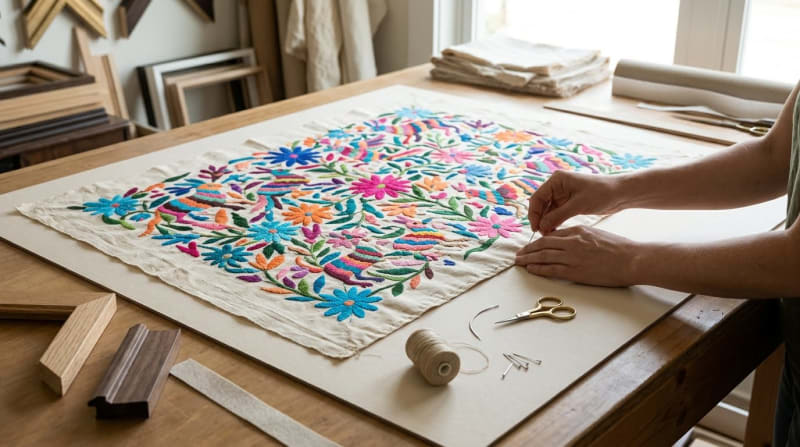
For an authentic piece, mounting the sheet inside a shadowbox or floating it between two panes of museum glass allows the fibrous deckled borders to stand out while protecting the artwork from airborne dust. A proper floating mount showcases the uneven perimeter, proving that the piece was beaten by hand rather than trimmed by an automated factory blade.
Bringing Organic Texture Into Contemporary Spaces
Incorporating Otomi amate wall art into a living area comes down to balancing textural depth against visual noise. If an open-concept living room feels slightly echoey, stark, or overly clinical, woven fiber sheets absorb sound and break up expansive, empty walls better than glossy acrylics or framed posters.
A single large amate sheet makes a striking focal point above a low credenza or sofa, especially when paired with natural materials like linen upholstery, unpolished stone, and warm hardwoods. Smaller bark panels fit naturally into layered gallery walls, introducing earthy variations alongside photography and oil paintings.
At Lanna Ha and casalannaha.etsy.com we source amate bark paper art directly from artisan families in central Mexico, honoring the centuries-old stone-beating tradition while giving modern homes access to authentic folk art. Designing a space around genuine artisan work reflects the idea that curating a home with strong cultural identity outlasts fleeting trends. Hanging framed amate paper in a living room ensures an investment in enduring craftsmanship rather than disposable decor.